
Household Chore List: Daily, Weekly, Monthly, and Seasonal Chores
Updated November 17, 2026
This list groups common household chores by how often they come up, then by room. Use it as a starting point: cross out what doesn’t apply, add what’s missing, and change how often to fit your home. The fire safety and food storage items follow U.S. government pages (checked November 17, 2026). The rest are common routines, not rules.
Quick answer
- Every day: Dishes, kitchen counters, a quick tidy, trash when it’s full, and pets. Clean the dryer’s lint filter every time you use the dryer.See the daily list
- Every week and every month: Weekly bathroom and floor cleaning, sheets, and a fridge check. Every month, test your smoke alarms and do the deeper jobs.See the weekly listSee the monthly list
- Sharing the list: Agree on what each chore includes, then pick a way to split it: fixed owners, a rotation, or a weekly sign-up. Keep it where everyone can see it.See how to share chores
Daily chores
These small jobs keep the house from piling up. Most take a few minutes each.
- Kitchen: Wash the dishes or load and run the dishwasher. Wipe the counters, the stovetop, and the table. Sweep up crumbs.
- Living areas: Put things back where they belong. Fold blankets and straighten cushions.
- Bedrooms: Make the beds. Put clothes in the hamper or back in the closet.
- Bathrooms: Hang up towels and give the sink a quick wipe.
- Trash: Take out the trash and recycling when they’re full.
- Laundry: Run a load if the hamper is full. The U.S. Fire Administration says to clean the lint filter every time you use the dryer.
- Pets and plants: Feed pets and refill their water. Check plants that need daily water.
- Mail and papers: Sort the mail. Recycle what you don’t need and put bills and forms in one spot.
Weekly chores by room
- Kitchen: Clear out old food from the fridge and wipe the shelves. Wipe the microwave and appliance fronts. Mop the floor. Swap out dish towels and sponges.
- Bathrooms: Clean the toilet, sink, tub or shower, and mirror. Mop the floor, empty the trash, and put out clean towels.
- Bedrooms: Change the sheets. Dust surfaces and vacuum the floor.
- Living areas: Dust, vacuum or mop, and wipe light switches, doorknobs, and remotes.
- Laundry: Wash towels and sheets along with the regular loads.
- Around the house: Put the trash and recycling out on pickup day. Water plants. Plan meals and make the grocery list.
The fridge check: FoodSafety.gov lists 3 to 4 days in a refrigerator at 40°F or below for many leftovers, such as cooked meat or poultry, pizza, and soups and stews. A weekly look through the fridge is a good time to toss what’s past that. Check the chart for other foods.
Monthly chores
- Smoke alarms: Press the test button on each alarm. The U.S. Fire Administration says to test smoke alarms monthly.
- Kitchen: Clean the range hood filter, wipe inside the cabinets you use most, and clean the dishwasher filter if your model has one.
- Floors and walls: Vacuum under furniture and cushions. Wipe baseboards, door frames, and vents.
- Bathrooms: Wash bath mats and the shower curtain liner. Clear hair from drains.
- Supplies: Check what’s running low: cleaning supplies, toiletries, batteries, and light bulbs.
- Decluttering: Clear out one drawer, shelf, or closet.
Seasonal and yearly chores
These jobs come up a few times each year. Some homes do a bigger round in spring and fall.Use the printable house cleaning checklist
- Every season: Wash windows and screens. Deep clean the oven and the fridge. Wash curtains, pillows, and blankets. Swap out seasonal clothes and gear.
- Outside: Clean gutters, sweep the porch or balcony, and put away or bring out outdoor furniture.
- Every year: Clean the dryer vent ductwork, as the U.S. Fire Administration advises. If your smoke alarms use 9-volt batteries or are hardwired with a backup battery, replace the batteries at least once every year. The agency also says smoke alarms need to be replaced 10 years from the manufacture date.
- Supplies and paperwork: Check expiration dates in the medicine cabinet and first aid kit. Look over warranties and manuals for things you no longer own.
Track chores in a shared app
A paper chart works when everyone walks past the fridge. If you want reminders and a record of who did what, you can set up recurring chores in an app everyone uses. Here are the steps in ienon.
How to set up recurring chores in ienon
- 1Bring everyone into the same Home. The first person opens the top-left menu in “Home”, taps “Invite”, then taps “Copy Invite Link” and sends the link. An invitation link or QR code can invite up to 5 people and is valid for 7 days.
- 2Open “Chore”, tap +, and choose “Create Schedule”. Enter the chore name. If “Chore” isn’t in your tabs, open it from “Apps”.
- 3Set “Recurrence” and “Assignee”. To take turns, use “Rotation”, then press the creation button at the bottom.
- 4When the chore is done, tap it under “Tasks”, choose “Completed by”, and tap “Done!”. Select the person who actually did it, even if that differs from the assignee.
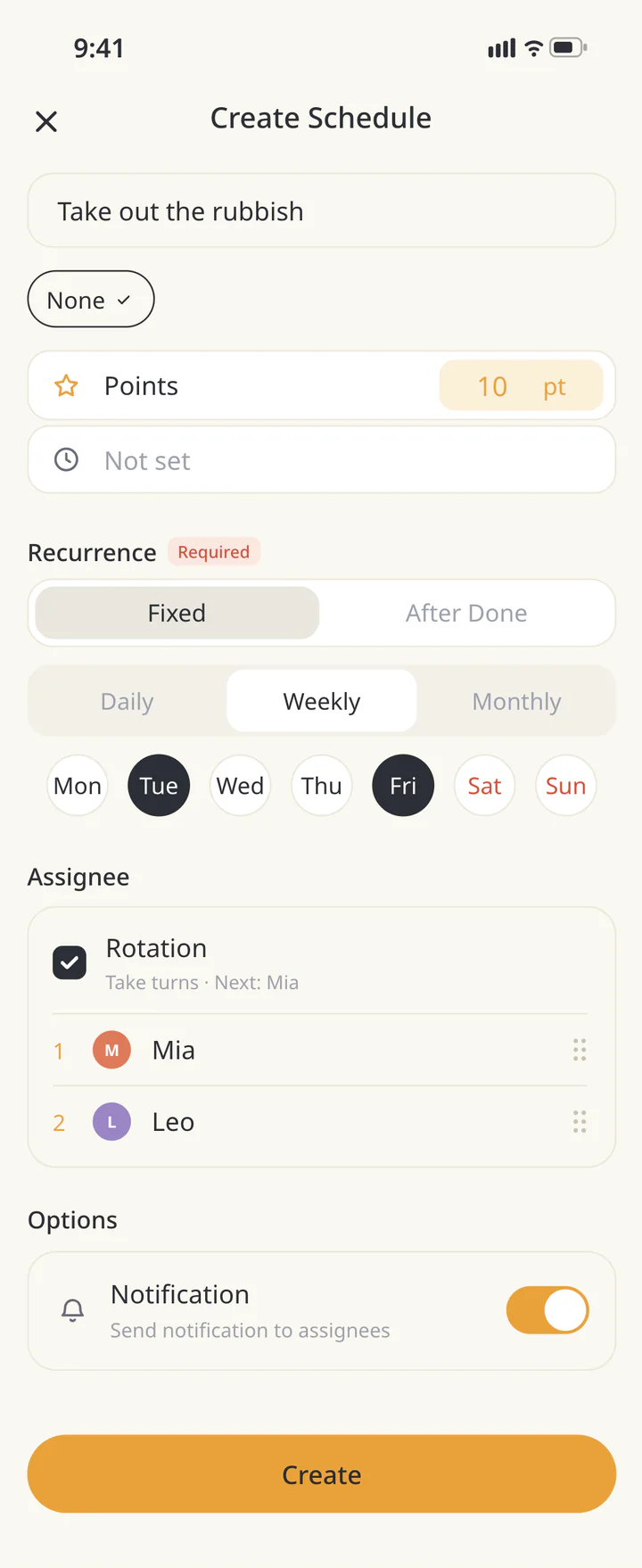 Add a recurring chore
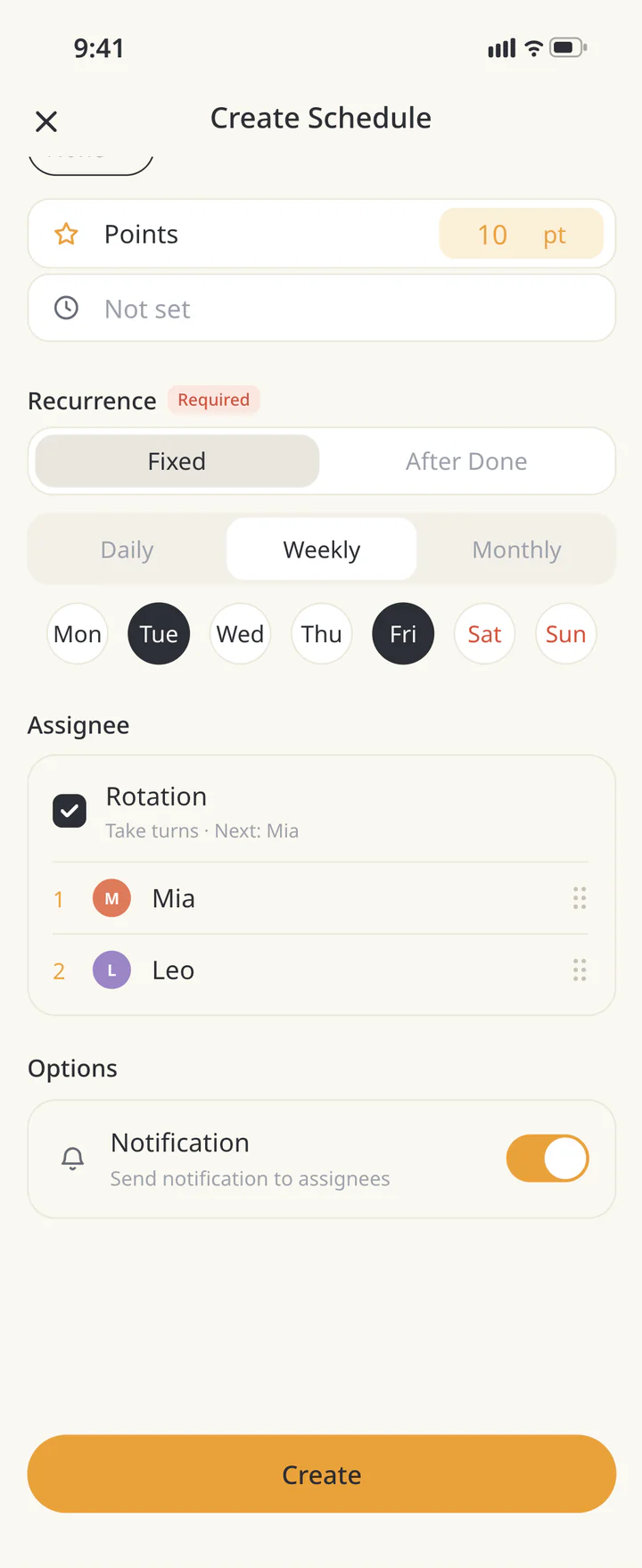 Set the schedule and turns
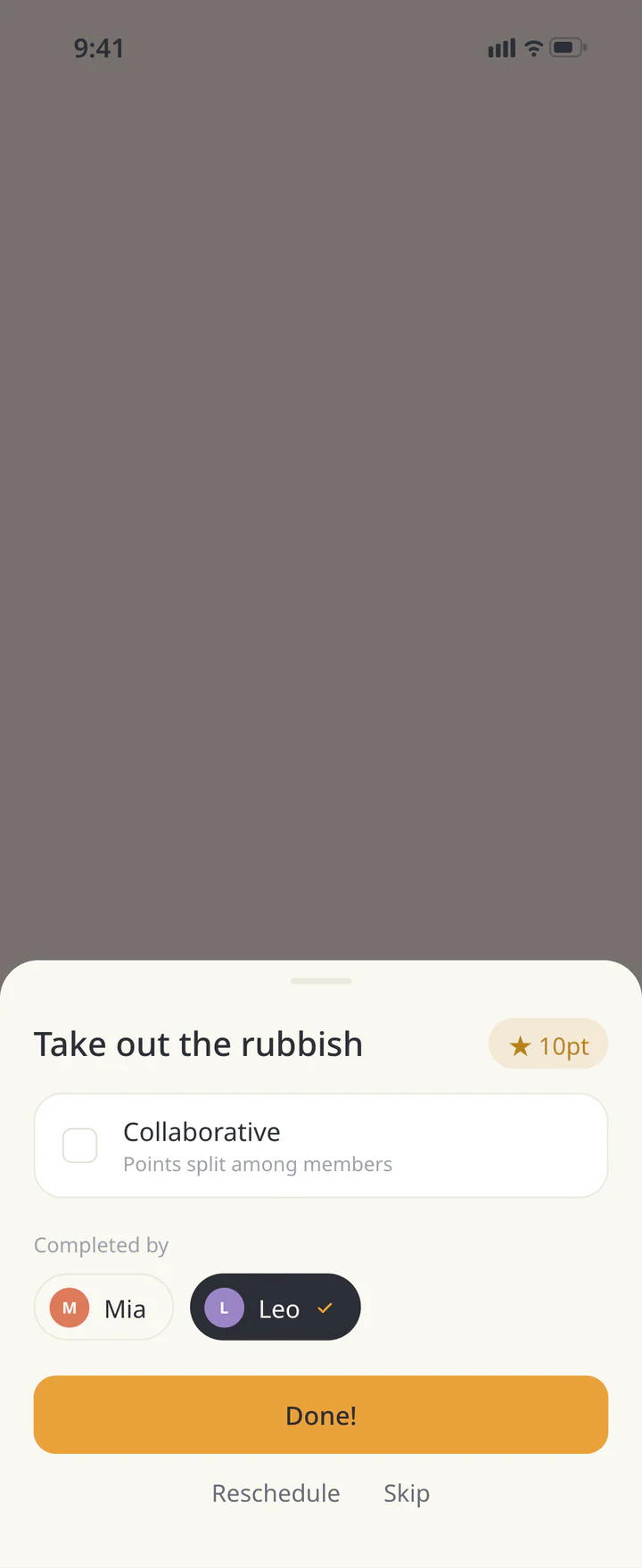 Mark it done with the right person


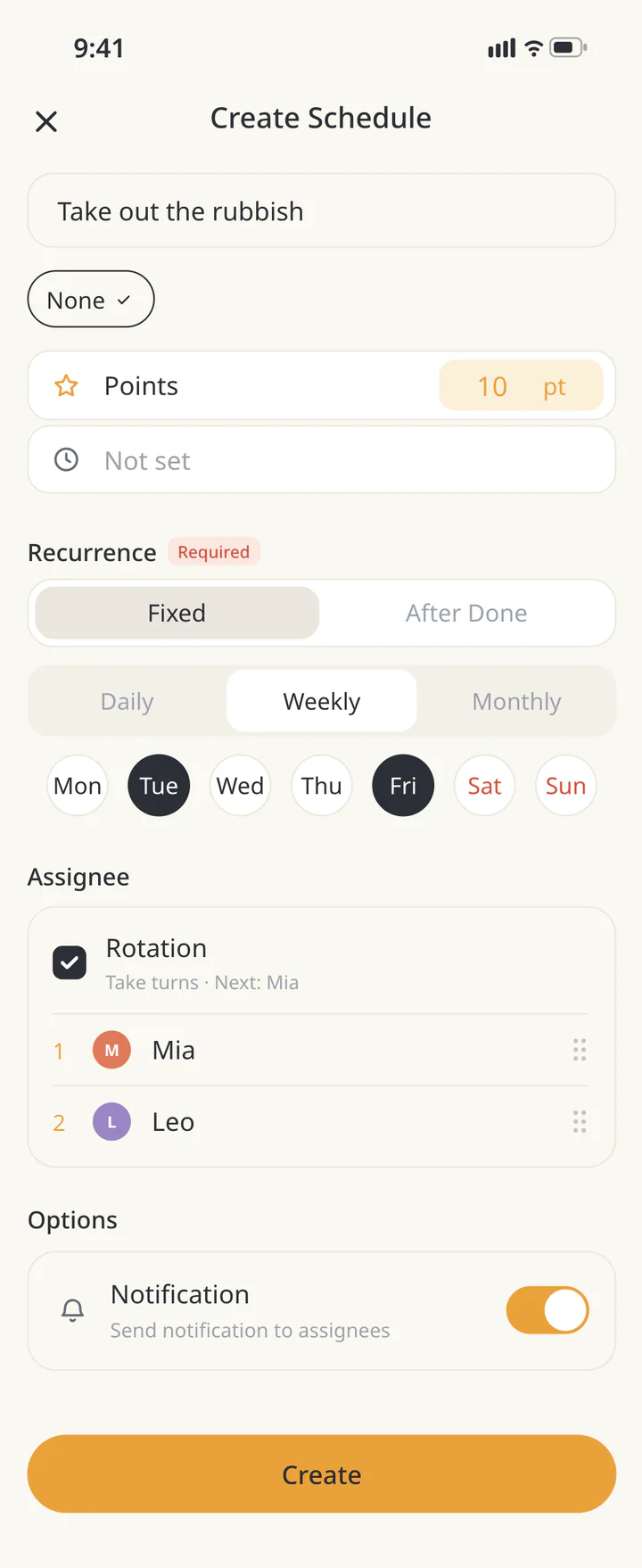

Things to know in ienon
- Everyone installs it: Each person installs ienon and signs in with their own Apple or Google account. The Apple option appears on supported devices. You don’t need to share login details.Invite someone to your Home
- One-off jobs: A to-do works for a one-off job with a deadline. Use “Chore” for recurring duties and taking turns, and keep each job in one place so it isn’t checked off twice.Set due dates, recurring tasks, and chores
- Alerts: If chore alerts don’t arrive, check the chore settings, the Chores switch in notification settings, and your phone’s notification permission.
- The record is a starting point: A visible record helps you talk, but a task name doesn’t capture its effort. Review the plan together.
Frequently asked questions
QWhat chores should be done every day?
Common daily chores include washing the dishes, wiping the kitchen counters, a quick tidy, and taking out the trash when it’s full. If you have a dryer, the U.S. Fire Administration says to clean the lint filter every time you use it.
QHow do we split chores fairly?
There’s no single right split. Start by listing every chore, including the small ones, and agree on what each one includes. Then choose fixed owners, a rotation, or a weekly sign-up, and look back after a few weeks.
QHow do roommates usually split chores?
A common setup is for each person to keep their own room clean and to rotate the shared spaces, such as the kitchen, bathroom, and trash, every week. A chart on the fridge or a shared app shows whose turn it is.
QHow often should I test smoke alarms?
The U.S. Fire Administration says to test smoke alarms monthly. For alarms with 9-volt batteries, it says to replace the batteries at least once every year. Smoke alarms need to be replaced 10 years from the manufacture date.
QCan I print this chore list?
Yes. Use your browser’s print option to print this page, then cross out what doesn’t apply. To print a weekly chart with names and checkboxes, use the Chore Chart or the Roommate Chore Chart.
Sources
- U.S. Fire Administration (FEMA), “Smoke Alarms.” Accessed November 17, 2026.usfa.fema.gov: Smoke Alarms
- U.S. Fire Administration (FEMA), “Basement and Garage Fire Safety.” Accessed November 17, 2026.usfa.fema.gov: Basement and Garage Fire Safety
- FoodSafety.gov, “Cold Food Storage Chart.” Accessed November 17, 2026.FoodSafety.gov: Cold Food Storage Chart
Keep your chore list in one shared place
With ienon, everyone in the same Home can see whose turn it is and who did what, next to your calendar and grocery list. ienon is free to start.